

Set & Setting
Don't blame the mushrooms

I was recently sitting in a sauna, sweating my ass off next to someone I just met. Very quickly, we found ourselves chest deep in a conversation about everything that makes me tick: existential psych, death anxiety, consciousness — the whole shebang. We lobbed the conversation back and forth enthusiastically, while I was occasionally struggled to squeeze out words due to the singing pain in my lungs (I’m a wet heat girl). *wipes upper lip and prays for moisture other than plentiful sweat* But GOODNESS do I love to fall down the rabbit hole with strangers.
Unsurprisingly, somewhere in that sweaty, cedar-scented conversation, we found our way to psychedelics. He’d been curious… had been thinking about trying mushrooms. What did I think?
I gave the same answer I always give. The one I’ve given, at this point, more times than I can count, in all kinds of settings including, apparently, saunas. More than anything, it’s a very basic nugget of information that I feel everyone interested in trying psychedelics should be aware of:
Classic psychedelics are non-specific amplifiers. Whatever is present in your psychological landscape is what the experience is going to magnify. The substance isn’t calling the shots as much as you might think.
So before we talk about dosage or strain or any of the other things people usually ask about, we need to talk about set and setting.
Phrase Lineage
You’ve no doubt heard of “set and setting,” but there’s a decent chance you are unaware of the phrase’s rich lineage. The terms were in use as early as 1958, attributed to the Austrian biologist Ludwig von Bertalanffy. They entered the mainstream psychedelic conversation on September 9th, 1961, when Timothy Leary presented a paper on the topic at the annual meeting of the American Psychological Association.
Before Leary formalized it, the concept was already being practiced. Al Hubbard—dubbed the “Johnny Appleseed of LSD”—was among the first to understand that the container mattered as much as the compound. He introduced a treatment space deliberately designed to feel more like a home than a clinical environment, complete with soft lighting, music, plants, and art. This space became known as a “Hubbard Room,” and it was a radical departure from the sterile psychiatric settings of the time.
In 1964, Leary, Metzner, and Alpert articulated set and setting explicitly in The Psychedelic Experience: A Manual Based on the Tibetan Book of the Dead.
They wrote,
“Of course, the drug dose does not produce the transcendent experience. It merely acts as a chemical key — it opens the mind, frees the nervous system of its ordinary patterns and structures. The nature of the experience depends almost entirely on set and setting.”
Set, in their definition, encompasses the preparation of the individual — personality structure, mood, expectations. Setting is physical, social, and cultural. Together, set and setting form a framework that, over sixty years later, remains integral to the foundation of responsible psychedelic practice.
More recently, Hartogsohn traced the concept even further back, pointing out that members of the Club des Hashischins, a Parisian group dedicated to exploring psychoactive-induced experiences in the 1840s, were already writing about the necessity of approaching such experiences with a tranquil frame of mind and body. The insight, it turns out, predates the psychedelic renaissance by well over a century.
Set, Setting, and Non-Specific Amplification
Set is your interior landscape.
It includes things like your mood, your intentions for the experience, whatever anxieties or unresolved material you’re carrying. But it also includes deeper, less visible things: your relationship with uncertainty, your history with difficult emotions, the degree to which you trust yourself to move through hard psychological terrain. Researchers now describe this as having both an immediate and a long-range dimension. Your immediate set is what you bring to a specific session: your state of mind that day, your hopes and fears about what might unfold. Your long-range set is everything underneath that: personality, personal history, formative experiences, and mental health history. You don’t get to leave any of it at the door.
Setting is the container.
The physical environment: whether it’s comfortable, familiar, genuinely safe. The social environment: who is present, what your relationship to them is, and whether you trust them not just as people but as people capable of holding space for whatever might come up. Being with someone who has no experience with altered states and no framework for understanding them is a different setting than being with someone who does, even if the room looks the same. And then there is the broader cultural setting: the framework within which you understand and make meaning of the experience.
Non-Specific Amplification
The non-specific amplifier principle tells us that set and setting are more than just suggestions for optimizing a pleasant afternoon. They are, functionally, the experience. The psychedelic substance creates the conditions for amplification; what gets amplified is whatever you’ve brought with you. A person carrying unprocessed grief, unacknowledged anxiety, or a fragile relationship with their own inner life is not going to have a difficult experience because psychedelics are inherently dangerous. They may have a difficult experience because the psychedelics reveal their internal state, or make previously hidden psychic materials more readily available. Whether that difficulty becomes transformative or destabilizing depends enormously on what preparation occurred before the first dose was taken, as well as what integration is done in the days and weeks that follow.
Set & Setting ≠ Pre-Flight Checklist
I’ve encountered a tendency, especially in recreational contexts, to treat set and setting as a checklist.
Pick a good playlist ✔️
Clean your space ✔️
Make sure you’re with someone you like ✔️
Have water and snacks available ✔️
While these things do genuinely matter, the more significant pre-trip preparatory work is interior.
Preparation in the fuller sense means doing an honest accounting of what you’re carrying, or what you’re bringing into the experience with you. It means having some clarity about intention, including a genuine sense of why you want the experience and what you’re hoping to encounter or move through during it. It means having considered what might be difficult and whether the support structures around you are adequate to hold that difficulty.
I’m a big fan of Earleywine and De Leo’s characterization of the fuller framework as scaffolding. The psychedelic experience is most generative when it sits within a continuous process of preparation, exploration, and integration, rather than occurring as an isolated event dropped into an otherwise unprepared life.
That third component, integration, tends to get the least airtime while arguably mattering the most. Whatever opens during a psychedelic experience doesn’t automatically resolve itself. There is a window of neurological flexibility that follows, a period of genuine cognitive openness, and it is possible to do a great deal with that window. (More on the risks that come with that openness in this piece.) It is also possible to let it close without doing much of anything. Old patterns have a remarkable capacity to reassert themselves, particularly in the absence of any intentional effort to work with what arose. As Jack Kornfield put it: after the ecstasy, the laundry.
A Mirror, Not a Door
The sauna conversation didn’t get this far into the weeds (too hot!). But this is where I always aim to land, because I believe that employing a deep and complete understanding of set and setting can help to determine whether a psychedelic experience becomes genuinely meaningful or simply a very interesting afternoon that fades into anecdote.
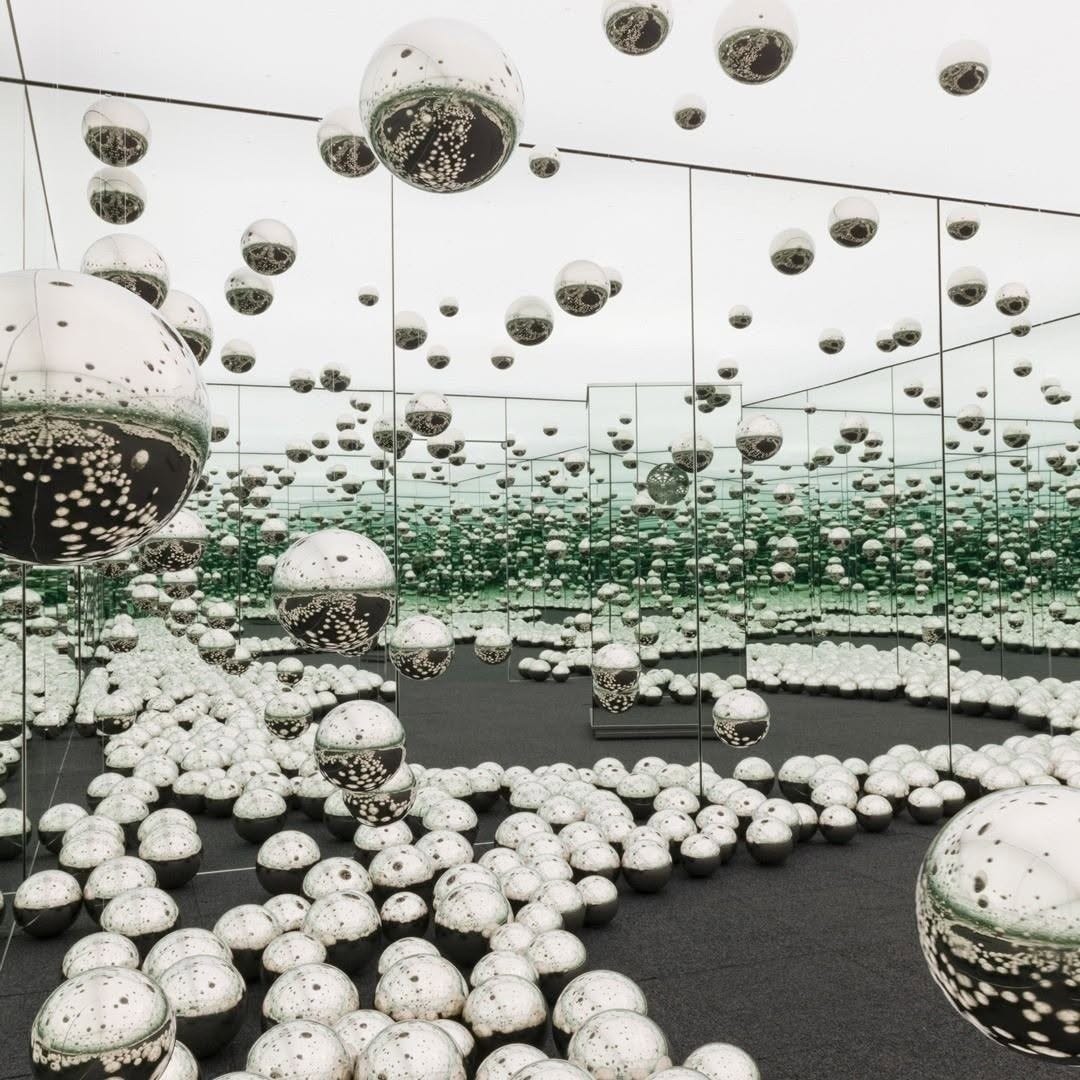
A mirror doesn’t create what it reflects, it shows what is already there. Psychedelics are, in this sense, less a door to somewhere else and more a particularly unsparing light turned on the mirror-filled room you’re already standing in. What you find depends on what you’ve brought, how well you’ve prepared to look, and whether you’re willing to do something with what you see.